"Every house where love abides
And friendship is a guest,
Is surely home, and home sweet home
For there the heart can rest."
Henry Van Dyke
I owe thanks to Tenzin Dolkar (who I like to think of as my one and only Tibetan reader) for introducing me to her good friend, Pema, when she found out that I was going on holiday in her hometown back in April. It was a shame that I did not get to meet Tenzin too since she no longer lives in McLeod Ganj, but life's unfair like that. Contrary to the curmudgeonly, misanthropic image I tend to project, I genuinely do enjoy meeting new people and having meaningful conversations with them.
Pema was a delight and a darling. She's sweet, chatty, hospitable, and knows practically everyone in town. Out of the four weeks I spent roving about Western Himalayan region, three of them were spent in Dharamsala and the surrounding towns and villages - and in that time, I had met up with Pema about four times over a cuppa or a bite. We spoke at length about a great many pertinent subjects like regional and international politics, Tibetan culture, local attractions, human rights, medicine, religion, books, films, and food (of course). We also had words about that pervasive, pulsing issue close to every exiled Tibetan's heart: the dream of a free Tibet.
Pema has very realistic and pragmatic views on the matter. She knew the People's Republic of China will never unclench its greedy claws around her people's land or grant Tibetans true autonomy in their own governance, but still she strives for it. I agree with her almost unreservedly, but a dialogue between two minds mirroring one another is seldom fruitful and never interesting. So, I went meta - I wanted to quiz her about the thoughts behind her thoughts. Terry Pratchett's Tiffany Aching satirical fantasy series for children has this immensely sensible concepts of First Sight and Second Thoughts which not nearly enough adults know about (but should). First Sight is the ability to see what's there instead of what you think is there. Second Thoughts are the thoughts you think about the way you think.
"Do you want Tibet freed?" I asked her point blank over coffee at Moon Peak Cafe.
"Of course!" she told me emphatically. "It's my homeland!"
I enquired further. I asked if she was born there.
"No, I was born here in India," she said.
"Have you ever been to to Tibet?"
"No..." She then smiled, understanding what I was getting at. "It's odd but somehow, I feel a very strong connection to that place."
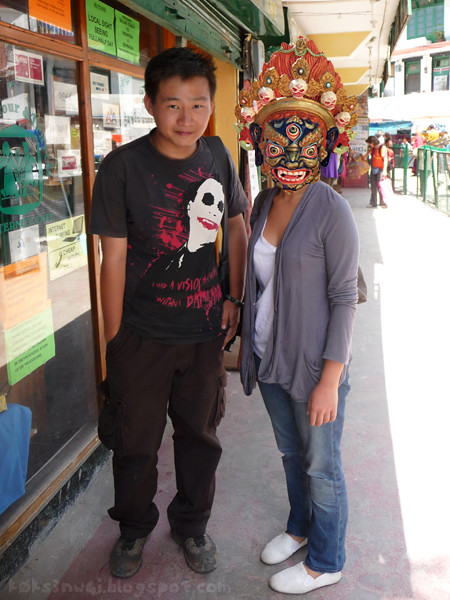 |
| Pema, my Tibetan Spirit Guide™, enjoys her anonymity so I photoshopped a Vajrapani mask over her face. |
That is what I truly find fascinating. She has in mind a home in a country she was not born in, and yearns to return to a land that had never heard her footfalls. Why? Why indeed.
My life story parallels Pema's but with a radically different perspective. I am ethnically Chinese and my grandparents came to the Malay Archipelago from villages in China I cannot even name, let alone pronounce. I was born here in Malaysia, and I grew up breathing Malaysian air and drinking Malaysian water. At no point in my entire existence do I even entertain the thought of China as my home. I feel absolutely no longing for the patch of dirt which some dead stranger related to me by blood happened to have been birthed on. Unlike some Malaysian Chinese who harbour borrowed pride of China's every successes and would reflexively defend China's every transgression in the world's eye, I find almost everything about the People's Republic deplorable; their values running counter to everything I cherish and stand for.
When I first landed on Indian soil in 2006 with more than a hundred other Malaysians, I realised for the first time just how powerful the idea of a home can be. Homesickness was a visible, tangible disease around campus. I've heard of how my colleagues - some of them grown men - cry themselves to shambles in their hostel beds at night, moaning like stuck pigs for a mere physical location they feel sentimental for. Eventually, a few cracked under the duress and chose to quit medical school before the first semester was up just to return to familiarity. It their first time away from home for any substantial period of time, you see, and the shock proved to be too much for them to withstand. It ironic that some of these homesick Malaysians descended from Indian migrants, and India is actually their ancestral crib.
Meanwhile, I also noticed that I am completely immune to homesickness and one has to wonder if it's because I'm deficient in some ways in the attic. If I am a Tibetan refugee, do I have it in my heart to ache for Tibet?
Perhaps, it's just the way I think about the way I think. My idea of home is protean. Sometimes, it's a person - a lover - and the warmth between her arms, and in other times, it's a state of mind. A home may mean the whole world to many but the whole wide world is home to me. Those are words I live by. The rest, if that's how one chooses to parse it, are simply details.
What does "home" mean to you?
P.S. Thanks you, Pema and Tenzin, for helping to make McLeod Ganj a home for me.
Always home,
My life story parallels Pema's but with a radically different perspective. I am ethnically Chinese and my grandparents came to the Malay Archipelago from villages in China I cannot even name, let alone pronounce. I was born here in Malaysia, and I grew up breathing Malaysian air and drinking Malaysian water. At no point in my entire existence do I even entertain the thought of China as my home. I feel absolutely no longing for the patch of dirt which some dead stranger related to me by blood happened to have been birthed on. Unlike some Malaysian Chinese who harbour borrowed pride of China's every successes and would reflexively defend China's every transgression in the world's eye, I find almost everything about the People's Republic deplorable; their values running counter to everything I cherish and stand for.
When I first landed on Indian soil in 2006 with more than a hundred other Malaysians, I realised for the first time just how powerful the idea of a home can be. Homesickness was a visible, tangible disease around campus. I've heard of how my colleagues - some of them grown men - cry themselves to shambles in their hostel beds at night, moaning like stuck pigs for a mere physical location they feel sentimental for. Eventually, a few cracked under the duress and chose to quit medical school before the first semester was up just to return to familiarity. It their first time away from home for any substantial period of time, you see, and the shock proved to be too much for them to withstand. It ironic that some of these homesick Malaysians descended from Indian migrants, and India is actually their ancestral crib.
Meanwhile, I also noticed that I am completely immune to homesickness and one has to wonder if it's because I'm deficient in some ways in the attic. If I am a Tibetan refugee, do I have it in my heart to ache for Tibet?
Perhaps, it's just the way I think about the way I think. My idea of home is protean. Sometimes, it's a person - a lover - and the warmth between her arms, and in other times, it's a state of mind. A home may mean the whole world to many but the whole wide world is home to me. Those are words I live by. The rest, if that's how one chooses to parse it, are simply details.
What does "home" mean to you?
P.S. Thanks you, Pema and Tenzin, for helping to make McLeod Ganj a home for me.
Always home,
k0k s3n w4i