
"In the strict scientific sense we all feed on death - even vegetarians."
Mr. Spock
For the longest time, more out of pure laziness than any other excuse, I have taken the word of a vegan acquaintance of mine and assumed that veganism is very much better for the environment than eating meat. At first blush, the maths do check out - farm animals belong to a higher trophic level & them smelly cows do fart a lot - so logically, meat production necessitates a higher burden on our resources than, for example, the humble workaday cabbage. The full vegan pitch is far longer and far more irritating, but that's really not my job to present it - or at least, it isn't anymore. While I lack the resolve to commit myself (and my family) to a vegan diet, I do try however to be mindful of the amount of delicious flesh I consume everyday and visit a local vegetarian joint semi-regularly. Whenever the topic of veganism and sustainability comes up, I just repeat what I learned from that vegan acquaintance of mine and shared much of the same references he shared with me. I recognise that I am holding out because
Anyway, I have no cause to question what my herbivorous friend had told me (for years) until that same friend confronted me again regarding my choice to stick with a omnivore's diet this week on Twitter. Now, I am aware of the backfire effect - people confronted about their beliefs tended to dig in and double down rather than change their minds - and I am sure that that is precisely what occurred to me as that vegan friend prattled on and on about what a irresponsible jerk I am for not giving up meat.
However, in the process of backfiring and digging my trenches, I was forced to unearth and re-examine a lot of "facts" I had taken for granted and parroted in the veganism slash sustainability debates and in the process, I learned, for one thing, more about how alarmist vegans are great at cherry-picking stats and numbers to inflate their own contribution and sense of importance to the environment. I told that vegan friend that what he was doing to me was probably futile, given that I already agree with him on his talking points but because he couldn't shut up about how shitty a person I am for enjoying a chicken dinner, I went the extra mile to vindicate my own position. The sum result of all his high-horsing is that I now hold a less favourable position on veganism. Nice job breaking it, vegan.
The reason supplied to me for my tongue lashing from the vegan was because I tweeted a photo of my dinner. In the photo was a cut of chicken katsu I fried up myself. The vegan said,
 |
| And it triggered an urge in me to punch him in the teeth. True story. |
"Trigger" is a word that is appropriated by the internet from psychiatric language and in my line of work, we usually use it to refer to "trauma triggers" and it is a serious thing. Judging from the vegan's words, I sincerely doubt that he was "triggered" in the Post-Traumatic Stress Disorder sense of the word (just as I sincerely doubt he was actually diagnosed with PTSD). Furthermore, I pointed out to him that he is completely surrounded by "triggers" everywhere he goes considering that more than 95% of people eat meat and images of meat permeates the world. He should be a nervous wreck by now if he was genuinely triggered. Way to go in cheapening the experience of shell-shocked veterans and victims of sexual assault.
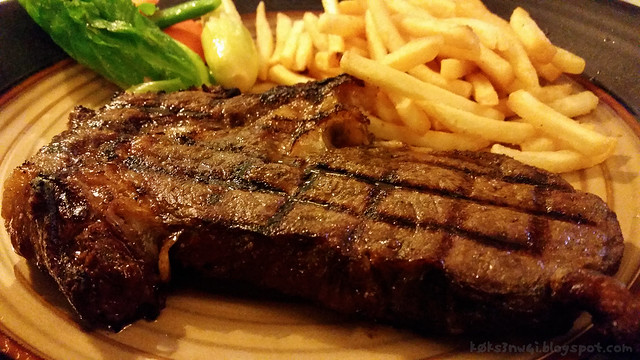
Speaking of "triggers" (in the annoying internet jackasses sense of the word), I went out of my way and ate a huge slab of sirloin steak last night after having abstained from beef for months - as a reward to myself for having suffered a bout of vegan evangelism. In fact, the last time I ate an honest-to-goodness beef steak was literally years ago. I am not even joking here: all that talk about the unsustainability of beef actually "triggered" me to crave for a medium-rare side of cow which I have been missing.
Here is what I had last night,
But let's get to the meat of this post, which are mostly things which environmento-vegan rangers tend to gloss over or omit in their guilt-tripping sales pitch, in no particular order:
Fertilisers.
One of the basic things we can all agree on is that when applied intelligently, mixed farming (crops plus livestock) is the more sustainable model in food production. One very obvious advantage is that manure from the animals can be used to fertilise the plants but according to this report by the USDA, only a measly 5% fraction of total planted acreage even received manure and it's not because manure is in short supply. In fact, the US is drowning in so much shit that it threatens to be an environmental disaster if handled improperly. Manure is cheaper than commercial synthetic fertiliser, so what gives?
The reason why all that poo doesn't get spread around more is because 52% of harvested crop acres in the US are on farms with no livestock production at all and the cost of transporting that much crap is proving to be a deterrent for most farmers. So, they settled on using synthetic fertilisers. And if vegans have their way, we would end up fertilising 100% of our crops with synthetic fertiliser since they want to to put an end to animal farming.
And what is synthetic fertiliser made out of? Non-renewable resources like natural gas. That's sustainable alright.
The Emission Impact of Farm Animals Versus Plants.
Cows and sheep are flatulent and they fart more than soy and corn. Agreed. But what are the numbers really like, and how do we come to a more nuanced understanding of the issue without resorting to ultimata of utter meat rejection?
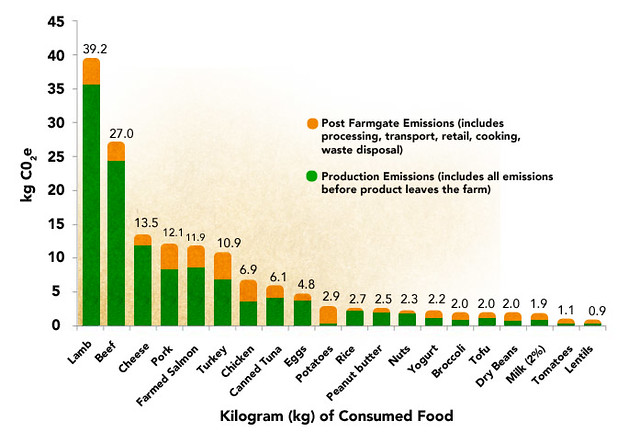
Here is a chart on production emissions (including emissions from processing, transportation, et cetera after the food leave the farms) from the EWG,
Lamb meat is the greatest offender here, with the production of 39.2 kilos of CO2 per kilo of consumed food with beef winning silver in the agricultural fart Olympics at 27 kilos. The reason why lamb generate so much emissions per kilo is because they produce less edible meat relative to the sheep's live weight - so, aside from putting a stop to lamb chops we should really boycott wool clothing as well. Also, lamb makes up less than 1% of the meat consumed by Americans anyway so giving up sheep-meat isn't going to matter much at all.
You'll notice immediately that after ruminants (hoofed animals with 4-chambered fart-generating stomachs), the emission levels dropped precipitously when we look at other sources of meat protein like pork and chicken. And just eyeballing the chart, you can tell that pork produces about 6 times and chicken about 3 times as much emissions as most plant-based food. Which is still significant, if you ignore the fact that meat is faaar more calorie-dense compared to vegetables and grains. I mean, if you stop eating beef, you can’t replace a kilogram of it (which has 2,280 calories) with a kilogram of broccoli (340 calories). You have to replace it with 6.7 kilograms of broccoli to make up the caloric difference.
So, a fairer and more science-literate comparison would be to look at emissions per 1,000 calories,
You'll notice right away that tomatoes and broccoli farming actually produce MORE emissions than farmed salmon, pork, chicken, canned tuna, milk, yogurt, cheese and eggs. But do you hear vegans bothering people who eat brocolli and tomatoes? No. Why? Studies showed that it's because they are oversized, wet, flopping hypocrites.
Of course, vegans will moan "What about methane?!" Yes, methane is way worse than CO2 when it comes to comparative impact on climate change.
You can see in the above graph that chicken produces nil enteric methane emissions. That's because physiologically, birds don't need to fart. While I can sort of see the point for abstaining or decreasing beef intake, I don't see any compelling environmental reason to give up poultry at all.
There is a reason why scaremongering documentaries like Cowspiracy place a lot of focus on beef production (aside from embarrassingly bad puns) because ruminant farming is an order of magnitude worse than poultry farming. While it is not outright lying, it is propaganda that downplays the fact that ruminant farming is exceptional in their negative impact on the environment and presenting numbers which look dire on face value, while playing pretendsies that a vegan diet is always better - ignoring the fact that pork and chicken can actually be better choices than some vegetarian alternatives. But of course, he chose to badger me because of my chicken katsu instead of giving his equally insufferable vegan friends friends pain for their marinara gluten-free pasta dinners.
Will my vegan friend give up tomatoes and broccoli and start eating chicken and pork again when faced with this evidence? I don't think so.
Vegan Culture's Obsession with Organic Farming, Fad Superfoods and Fighting GMO's.
There is no hard way to determine just how many vegetarians and vegans buy into organic farming - and how many of them unfairly malign the use of genetically modified organisms (GMO), but one can't help but notice a huge overlap in ideology there if one frequents blogs or pages which advocate plant-centric diets. It makes sense since they generally approach orthorexic levels of finickiness and scrutiny when it comes to what they stuff their faces with.
Organic farming produces about 20 to 30% less yield compared to conventional farming practices. That means that for every 100 kilos of zucchinis we produce through conventional farming practices, we can only produce 70 to 80 organic zucchinis.
 |
| "Vegetarian: A person who eats only side dishes." ~Gerald Lieberman |
But let's get to the meat of this post, which are mostly things which environmento-vegan rangers tend to gloss over or omit in their guilt-tripping sales pitch, in no particular order:
Fertilisers.
One of the basic things we can all agree on is that when applied intelligently, mixed farming (crops plus livestock) is the more sustainable model in food production. One very obvious advantage is that manure from the animals can be used to fertilise the plants but according to this report by the USDA, only a measly 5% fraction of total planted acreage even received manure and it's not because manure is in short supply. In fact, the US is drowning in so much shit that it threatens to be an environmental disaster if handled improperly. Manure is cheaper than commercial synthetic fertiliser, so what gives?
The reason why all that poo doesn't get spread around more is because 52% of harvested crop acres in the US are on farms with no livestock production at all and the cost of transporting that much crap is proving to be a deterrent for most farmers. So, they settled on using synthetic fertilisers. And if vegans have their way, we would end up fertilising 100% of our crops with synthetic fertiliser since they want to to put an end to animal farming.
And what is synthetic fertiliser made out of? Non-renewable resources like natural gas. That's sustainable alright.
The Emission Impact of Farm Animals Versus Plants.
Cows and sheep are flatulent and they fart more than soy and corn. Agreed. But what are the numbers really like, and how do we come to a more nuanced understanding of the issue without resorting to ultimata of utter meat rejection?
Here is a chart on production emissions (including emissions from processing, transportation, et cetera after the food leave the farms) from the EWG,
 |
| Okay, what are people doing to potatoes after they leave the farm? |
Lamb meat is the greatest offender here, with the production of 39.2 kilos of CO2 per kilo of consumed food with beef winning silver in the agricultural fart Olympics at 27 kilos. The reason why lamb generate so much emissions per kilo is because they produce less edible meat relative to the sheep's live weight - so, aside from putting a stop to lamb chops we should really boycott wool clothing as well. Also, lamb makes up less than 1% of the meat consumed by Americans anyway so giving up sheep-meat isn't going to matter much at all.
You'll notice immediately that after ruminants (hoofed animals with 4-chambered fart-generating stomachs), the emission levels dropped precipitously when we look at other sources of meat protein like pork and chicken. And just eyeballing the chart, you can tell that pork produces about 6 times and chicken about 3 times as much emissions as most plant-based food. Which is still significant, if you ignore the fact that meat is faaar more calorie-dense compared to vegetables and grains. I mean, if you stop eating beef, you can’t replace a kilogram of it (which has 2,280 calories) with a kilogram of broccoli (340 calories). You have to replace it with 6.7 kilograms of broccoli to make up the caloric difference.
So, a fairer and more science-literate comparison would be to look at emissions per 1,000 calories,
 |
| Perspective, bitches. |
You'll notice right away that tomatoes and broccoli farming actually produce MORE emissions than farmed salmon, pork, chicken, canned tuna, milk, yogurt, cheese and eggs. But do you hear vegans bothering people who eat brocolli and tomatoes? No. Why? Studies showed that it's because they are oversized, wet, flopping hypocrites.
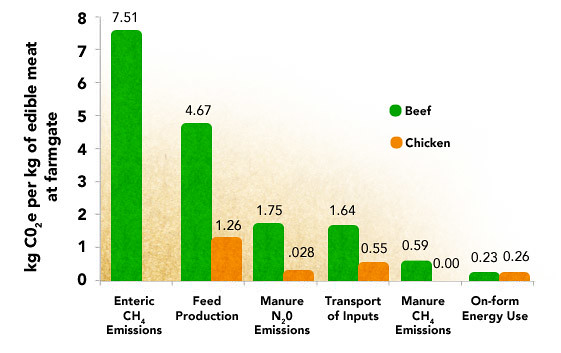
Of course, vegans will moan "What about methane?!" Yes, methane is way worse than CO2 when it comes to comparative impact on climate change.
 |
| I prefer chicken anyway. |
You can see in the above graph that chicken produces nil enteric methane emissions. That's because physiologically, birds don't need to fart. While I can sort of see the point for abstaining or decreasing beef intake, I don't see any compelling environmental reason to give up poultry at all.
There is a reason why scaremongering documentaries like Cowspiracy place a lot of focus on beef production (aside from embarrassingly bad puns) because ruminant farming is an order of magnitude worse than poultry farming. While it is not outright lying, it is propaganda that downplays the fact that ruminant farming is exceptional in their negative impact on the environment and presenting numbers which look dire on face value, while playing pretendsies that a vegan diet is always better - ignoring the fact that pork and chicken can actually be better choices than some vegetarian alternatives. But of course, he chose to badger me because of my chicken katsu instead of giving his equally insufferable vegan friends friends pain for their marinara gluten-free pasta dinners.
Will my vegan friend give up tomatoes and broccoli and start eating chicken and pork again when faced with this evidence? I don't think so.
Vegan Culture's Obsession with Organic Farming, Fad Superfoods and Fighting GMO's.
There is no hard way to determine just how many vegetarians and vegans buy into organic farming - and how many of them unfairly malign the use of genetically modified organisms (GMO), but one can't help but notice a huge overlap in ideology there if one frequents blogs or pages which advocate plant-centric diets. It makes sense since they generally approach orthorexic levels of finickiness and scrutiny when it comes to what they stuff their faces with.
Organic farming produces about 20 to 30% less yield compared to conventional farming practices. That means that for every 100 kilos of zucchinis we produce through conventional farming practices, we can only produce 70 to 80 organic zucchinis.
Also, GMO use had also lead to higher yields and more sustainable farming practices like decreased reliance on pesticides and yes, prevented 203 million tonnes of CO2 from being released into the atmosphere from less soil disturbance as well. If anything, I think genetically modifying our food organisms will be how we eventually solve the sustainability problem.
And every new "superfood" that these eat-right clowns buy into (quinoa, chia seeds,
açaí berries, goji berries, et cetera) will in turn create demand for these products and thus, cause the opening of more farms to accommodate these specialised crops. Yes, non-vegans do get sucked into these fads as well but these are all technically plant-based food.
Now, my vegan friend may not necessarily buy into organic farming practices (and all its associated woo) and fad diets nor is he against GMO, as far as I know. I bring this up because this is one of those unquantified elements that put into perspective how the vegan movement isn't necessarily as great as they say it is when it comes to sustainability. Individual vegans may even be worse than an average omnivore like me who is pro-GMO, anti-organic farming and gets most of my meat protein from chicken - particularly if that vegan eats a lot of tomatoes and broccoli.
Vegan Evangelism Isn't Going to Work.
I have no doubt that one day in the distant radiant future, humanity will no longer butcher any animal for their food (I am wagering on flawless, sustainable lab grown meat) but until that day arrives, we will be eating our hoofed and beaked friends for many decades or even centuries to come. So, on a pragmatic and practical level, I asked him how successful he is as spreading the Good News about veganism.
His reply was this:
That tells me that I am dealing with someone who puts ideology above actually focusing on doing what is actually effective.
After much dodging, he later said he had only convinced just 3 or 4 people to adopt veganism in all the years of his "activism". I have no way of knowing if the converts did so due to his highly annoying proselytising or if those 3 or 4 individuals were going to go vegan anyway, but I will generously give him the benefit of the doubt. Still, at a rate of about one conversion a year, he would still have done almost no good at the end of his life, however prolonged he imagine it would be thanks to his vegan diet. He would have annoyed a great many people though.
We also know that throwing evidence in the face of people largely doesn't work, as this study on the effectiveness of vaccination information campaigns suggests (that article even mentions the "backfire effect"). I mean, I already buy the party line that veganism is more sustainable and environmentally-friendly and I still refuse to adopt vegetarianism because it meant that I would have to sacrifice my quality of life. This is a losing battle. I ought to know - I counsel alcoholics and nicotine addicts everyday in my day job. I am technically at the "precontemplation" stage in regards to giving up meat and if I already agree that meat-eating is less sustainable than eating greens, then the right thing to do is to step back and be available if I actually want more information - but instead, this vegan friend's persistence had actually caused me to be less convinced than before.
Likewise, burning fossil fuels is bad but hardly anyone is willing to give up the convenience of modern transportations or electric lights. The solution to that is creating more fuel-efficient cars (or developing equally good electric cars), inventing more energy-saving light bulbs, investing in nuclear power or resorting to renewable energy sources like solar or wind. Doing the equivalent of screaming on street corners with a sandwich board pronouncing the doom of the world if we do not "repent" by stopping the use of cars or the consumption of meat is actually counter-productive (especially if it comes with insults implying I am irresponsible or evil or smelly) and it belies a fundamental misunderstanding of human nature: most of us will do what is easy rather than what is necessary. So real, practical solutions would have to come at no cost to our comfort in order for them be popular enough to make a significant difference. Adoption rate is key and king.
Veganism is not the Solution.
There are a million aspects of our lives which we can tweak to reduce our impact on the environment and on climate change but vegans like this Twitter friend of mine who harrassed me are disproportionately focused on their personal demons in their advocacy (meat, in this case).
You know what is far, far worse than eating meat? Having children. You can drive all the Priuses and eat all the kale in the world but that is but a drop in the ocean when you compare that to the carbon footprint of reproduction. I think all these vegans making sustainability arguments should sterilise themselves if they think that us omnivores aren't doing enough for the environment because they too are doing a half-assed job as well. It brings to mind this parable that Mencius told about a soldier who ran 50-paces away from the battlefield calling his fellow who ran 100-paces a coward (五十步笑百步).
In fact, I did say as much. I told that vegan friend to go kill himself if he really cares about the environment so much. To that, he said,
And every new "superfood" that these eat-right clowns buy into (quinoa, chia seeds,
açaí berries, goji berries, et cetera) will in turn create demand for these products and thus, cause the opening of more farms to accommodate these specialised crops. Yes, non-vegans do get sucked into these fads as well but these are all technically plant-based food.
Now, my vegan friend may not necessarily buy into organic farming practices (and all its associated woo) and fad diets nor is he against GMO, as far as I know. I bring this up because this is one of those unquantified elements that put into perspective how the vegan movement isn't necessarily as great as they say it is when it comes to sustainability. Individual vegans may even be worse than an average omnivore like me who is pro-GMO, anti-organic farming and gets most of my meat protein from chicken - particularly if that vegan eats a lot of tomatoes and broccoli.
Vegan Evangelism Isn't Going to Work.
I have no doubt that one day in the distant radiant future, humanity will no longer butcher any animal for their food (I am wagering on flawless, sustainable lab grown meat) but until that day arrives, we will be eating our hoofed and beaked friends for many decades or even centuries to come. So, on a pragmatic and practical level, I asked him how successful he is as spreading the Good News about veganism.
His reply was this:
 |
| In his mind, rousing inspirational music must be playing while a cape billows dramatically behind him. |
That tells me that I am dealing with someone who puts ideology above actually focusing on doing what is actually effective.
After much dodging, he later said he had only convinced just 3 or 4 people to adopt veganism in all the years of his "activism". I have no way of knowing if the converts did so due to his highly annoying proselytising or if those 3 or 4 individuals were going to go vegan anyway, but I will generously give him the benefit of the doubt. Still, at a rate of about one conversion a year, he would still have done almost no good at the end of his life, however prolonged he imagine it would be thanks to his vegan diet. He would have annoyed a great many people though.
We also know that throwing evidence in the face of people largely doesn't work, as this study on the effectiveness of vaccination information campaigns suggests (that article even mentions the "backfire effect"). I mean, I already buy the party line that veganism is more sustainable and environmentally-friendly and I still refuse to adopt vegetarianism because it meant that I would have to sacrifice my quality of life. This is a losing battle. I ought to know - I counsel alcoholics and nicotine addicts everyday in my day job. I am technically at the "precontemplation" stage in regards to giving up meat and if I already agree that meat-eating is less sustainable than eating greens, then the right thing to do is to step back and be available if I actually want more information - but instead, this vegan friend's persistence had actually caused me to be less convinced than before.
Likewise, burning fossil fuels is bad but hardly anyone is willing to give up the convenience of modern transportations or electric lights. The solution to that is creating more fuel-efficient cars (or developing equally good electric cars), inventing more energy-saving light bulbs, investing in nuclear power or resorting to renewable energy sources like solar or wind. Doing the equivalent of screaming on street corners with a sandwich board pronouncing the doom of the world if we do not "repent" by stopping the use of cars or the consumption of meat is actually counter-productive (especially if it comes with insults implying I am irresponsible or evil or smelly) and it belies a fundamental misunderstanding of human nature: most of us will do what is easy rather than what is necessary. So real, practical solutions would have to come at no cost to our comfort in order for them be popular enough to make a significant difference. Adoption rate is key and king.
Veganism is not the Solution.
There are a million aspects of our lives which we can tweak to reduce our impact on the environment and on climate change but vegans like this Twitter friend of mine who harrassed me are disproportionately focused on their personal demons in their advocacy (meat, in this case).
You know what is far, far worse than eating meat? Having children. You can drive all the Priuses and eat all the kale in the world but that is but a drop in the ocean when you compare that to the carbon footprint of reproduction. I think all these vegans making sustainability arguments should sterilise themselves if they think that us omnivores aren't doing enough for the environment because they too are doing a half-assed job as well. It brings to mind this parable that Mencius told about a soldier who ran 50-paces away from the battlefield calling his fellow who ran 100-paces a coward (五十步笑百步).
In fact, I did say as much. I told that vegan friend to go kill himself if he really cares about the environment so much. To that, he said,
 |
| I nearly asked him if it "triggered" him because he attempted or contemplated suicide before, but I realised that I have stopped caring by this point. |
We had been enjoying an omnivorous diet since time immemorial and we never had a problem with animal husbandry until recent times because - get this - meat is not the problem. It is a herring and it is red. The reason why meat farming is unsustainable (and eventually, crops farming as well) is because this is actually the toll that the continuously rising human population is having on this planet.
That's the fucking problem. Fix that.
Conclusion.
I try to minimise my own effect on the environment whenever I can if it does not come at a sacrifice in my quality of life. For example, I reject plastic bags whenever I shop but I'd still accept one if I really need it. I am mindful of the amount of meat I consume, both for environmental and health reasons. After the sialic acid Neu5Gc in red meat was found last year to be implicated in the increased risk of cancer, I have further reduced my already infrequent indulgence in red meat. When I bought home appliances recently for my new house, I tried to get the most energy efficient ones. And I decided to only have one child, and that alone already qualifies me for a higher horse than pretty much every vegan who birthed two kids or more. I make many of these little decisions everyday that counts towards my total impact on our world but to demonise one aspect of my life - my homecooked chicken katsu (which was delicious, by the way) - is incredibly misguided, unhelpful and tone deaf.
I am an atheist and I believe that this is the only life I will ever get to experience. I certainly don't intend to live it without all the reasonable comfort and pleasures I can get out of it. I don't want the trouble of limiting my culinary and epicurean experience, making sure I am getting enough Vitamin B12 through supplementation, or being a perpetual pain of the ass of a guest with "special considerations" at every group meal, party or wedding - all in service of a poorly thought out, mostly masturbatory non-solution to a serious issue.
Thinks vegans are pricks now,
k0k s3n w4i


