
"You can't reason someone out of a position they didn't reason themselves into."
Author unknown
The above quote, in its pithiest and most quotable form, has an unknown providence but it is a frequent lament of atheists and freethinkers on the subject of arguing with religious people. Because when it comes down to it, how does one hope to dislodge a theist's beliefs when usually, said beliefs had been indoctrinated into their minds since childhood, far before they have achieved the age of reason? Any "reason" that theists use to justify their strange miraculous beliefs, by necessity, had to have arisen ad hoc.
Indeed, too many times have Christians and Muslims told me, "You just have to accept it on faith! Once you have accepted it, it will make sense to you!" It was a sly gambit. They were hoping to pit my own faculties of reason against myself but fortunately, I am no fool - for only fools will accept something on faith before it is proven to them. If I say to you, "Just trust me. Sign your house over to me and I'll pay you RM1,000,000 afterwards," would you just take my word for it or would you at least have me sign some papers first or show you that I do actually have that kind of money?
Anyway, to return from my digression, there are really no good rational reasons for believers to believe in what fairy stories their parents, teachers, peers and clerics have passed down to them. It follows that you cannot then reason them out of said fairy stories. When I tried to trace the genesis of that astute aphorism, I was led to Sidney Smith (1771-1845), an English writer and Anglican cleric who apparently said,
"Never try to reason the prejudice out of a man. It was not reasoned into him, and cannot be reasoned out"
The attribution appeared in A Dictionary of Thoughts by Tryon Edwards from as early as 1891. Smith's words, however much it resembles the modern atheist watchword, speaks more on the nature of prejudices rather than the mechanics of acquiring and abandoning rhetorical positions. The similarity was but cosmetic. Though it is possible that the modern quote might have evolved from Smith's original saying, I remain unconvinced - so I dug further.
My investigation led me further back in literary history to Jonathan Swift (1667-1745), an Anglo-Irish satirist and essayist whose greatest claim to fame was authoring Gulliver's Travels in 1726. According to Treasury of Thought (1881) by Maturin Murray, Swift allegedly wrote,
"It is useless to attempt to reason a man out of a thing he was never reasoned into."
Now that is more like it! The quote fits the form and essence of the modern saying to a T! I would like very much to know the context in which the quote was written but the Treasury of Thought - it being nothing more than an oversized list of quotes - was quite unhelpful in this aspect, which meant that the answer I crave lies buried within Swift's body of work, all of which conveniently belongs to the public domain now in this day and age.
Finally, after looking through (or rather, after siccing all the power of a modern search engine against) the collected writings of Jonathan Swift on the internet, I think I might have discovered the surprising original context and the maiden wording of his quote. I will reproduce a large portion of my source here, but bear with it because I feel it is deserving of your patient attention,
"... And here I am at a loss what to say upon the frequent custom of preaching against atheism, deism, freethinking, and the like, as young divines are particularly fond of doing especially when they exercise their talent in churches frequented by persons of quality, which as it is but an ill compliment to the audience; so I am under some doubt whether it answers the end.
Because persons under those imputations are generally no great frequenters of churches, and so the congregation is but little edified for the sake of three or four fools who are past grace. Neither do I think it any part of prudence to perplex the minds of well-disposed people with doubts, which probably would never have otherwise come into their heads. But I am of opinion, and dare be positive in it, that not one in an hundred of those who pretend to be freethinkers, are really so in their hearts. For there is one observation which I never knew to fail, and I desire you will examine it in the course of your life, that no gentleman of a liberal education, and regular in his morals, did ever profess himself a freethinker: where then are these kind of people to be found? Among the worst part of the soldiery made up of pages, younger brothers of obscure families, and others of desperate fortunes; or else among idle town fops, and now and then a drunken 'squire of the country. Therefore nothing can be plainer, than that ignorance and vice are two ingredients absolutely necessary in the composition of those you generally call freethinkers, who in propriety of speech, are no thinkers at all. And since I am in the way of it, pray consider one thing farther: as young as you are, you cannot but have already observed, what a violent run there is among too many weak people against university education. Be firmly assured, that the whole cry is made up by those who were either never sent to a college; or through their irregularities and stupidity never made the least improvement while they were there. I have at least forty of the latter sort now in my eye; several of them in this town, whose learning, manners, temperance, probity, good-nature, and politics, are all of a piece. Others of them in the country, oppressing their tenants, tyrannizing over the neighbourhood, cheating the vicar, talking nonsense, and getting drunk at the sessions. It is from such seminaries as these, that the world is provided with the several tribes and denominations of freethinkers, who, in my judgment, are not to be reformed by arguments offered to prove the truth of the Christian religion, because reasoning will never make a man correct an ill opinion, which by reasoning he never acquired..."
Wow, right? I plucked the excerpt from A Letter to a Young Clergyman (January the 9th, 1719-20) written by The Very Reverend Dr Jonathan Swift, Dean of St Patrick's Cathedral in Dublin. He originally coined his maxim on reason when he was talking about the futility of proving Christianity to freethinkers.
I was also disappointed to discover that Jonathan Swift was a prejudiced imbecile. In that letter, Swift was advising young clerics to avoid preaching against atheism in case it puts ideas into their flock, effectively advocating thought-policing and censorship. He also thought that no moral person who received a liberal education ever professed to atheism, and claimed that all atheists are ignorant and immoral. I have no idea how most of the atheists were like in Swift's time but nowadays, studies have shown that atheists tended to be more intelligent, more liberal, more highly educated, and more ethical compared to religious people, the opposite of everything Swift said about non-believers. If Dr Swift is somehow alive today (perhaps through the sorcery of his deity), I wonder if I will be able to reason him out of his prejudice against atheists such as myself using evidence? Well, Sidney Smith is of the opinion that it is pointless to even try.
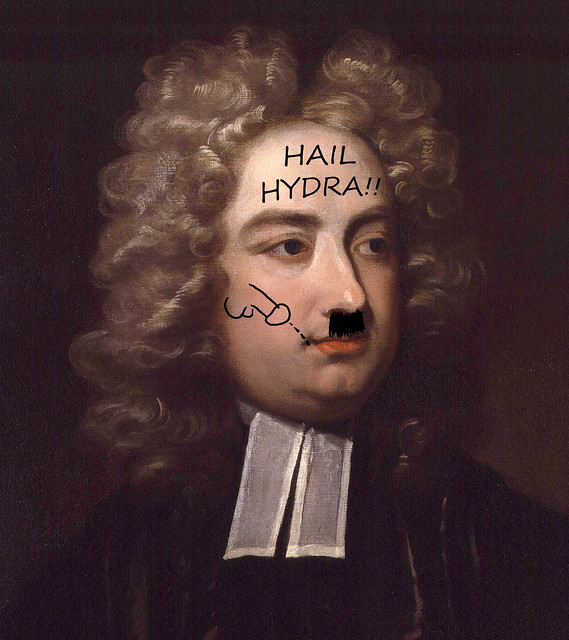 |
| Maybe I can't reason your prejudice out of you, Dr Swift, but I can totally do this. |
I also wonder at how many RPM's his corpse will spin when he finds out that modern atheists have unwittingly and ironically appropriated his quote to describe gentlemen of his breed and quality. To my fellow friends of liberal and godless secular philosophies I ask this question: how does it feel to find out that one of your favourite adages originated from a source contrary to everything you stand for?
Lost respect for Jonathan Swift,
k0k s3n w4i


