Wednesday, June 19, 2013

Peekaboo

"The candles lit
Waiting patient for me to sit
But none of last year’s clothes still fit
And I keep waiting for you to enter the room

I made my wish let me give it to you
When I turn 28
Things are gonna be great
At 28
At 28"


28 (2010) by Lorene Scarfaria

I know no one had noticed but the eye of my blog, my Panasonic Lumix DMC TZ15, had been blind for more than a year and I had been getting by with the camera on my phone. I messed around with the Crazy Cat Lady™'s Nikon D5000 occasionally (the first time I handled a DSLR camera, incidentally) but the device had proved too unwieldy for my purposes so it pretty much stayed in hibernation in its box for months on end.

Last Sunday, I unearthed it from storage because letting an expensive toy like it fossilise for future archaeologists seem like such a waste. While flipping through its SD card, I found a few untold glimpses into the past that I have forgotten about, and now I'm keeping them here so I don't forget them again. Some moments are worth commemorating, don't you think so?

Here is a snapshot of the gag birthday present I bought my wife.


Cempedak Birthday Surprise
A pregnant fruit for my pregnant wife.

She was in her first trimester and had been yenning cempedak for weeks (which was pretty tame as preggo-cravings go), so for her 28th birthday earlier this year, I got her one. I also led her to believe, for an entire day, that that was all I got for her and it was hilarious watching her try so hard to keep her disappointment from showing. What made the ruse so effective was my giving her a box of Pocky the day before, saying that that was all she was getting. So after that "pre-gag gift" gag gift, she didn't suspect a thing.

Here is a candid shot of her on her phone at her birthday dinner later that day,


Hilton 28th Birthday
If you look closely, you'd see that she's wearing the same top she wore on our first date.

I had the maître d serve her real birthday pressie during the dessert course (a Samsung Galaxy S III phone) but before then, I spent the entire evening trying to get her to admit that she was disappointed with the cempedak - but she valiantly kept up the happy grateful birthday girl façade. Didn't fool me a single minute, o' course.

Why marry someone when you are not going to mess with her mind at every opportunity you get with blatant lies?

Last Sunday, my shopping list read like an entry in Dali's diary, (1) a 2-kilogramme bag of low-calorie kitty kibbles, (2) a pair of ice cube trays, and (3) a hacksaw. This was because my cats are too fat, my drinks are too warm and Cheryl's coconut shell bangle is too small to be separated from her wrist without taking most of her wristbones with it.


Sawing of  the Coconut Bangle
She had it on since year 2005.

After a couple of nail-biting, gut-wrenching minutes, I broke through and she only lost like half a finger.


Broken Childhood
Faux-symbolic shot.

Her pregnancy had brought her a whole bag of gifts. One of them was a double-shot of carpal tunnel syndrome, and the hard, woody piece of accessory was not exactly kind to her wrist - so it had to go.

We are now about 10 weeks away from first contact with our Unborn Foetal Object
™. The wife is thinking of playing baby noises to the cats to prep them for the incoming invasion, so they wouldn't be spooked by the infantile wailings that will no doubt permeate our apartment in August. I believe we can use Justin Bieber's latest album for that purpose.

Oh, and a belated happy father's day wish to me, I guess. It might actually mean something if it comes with leave from work.


Chief wife-botherer,
k0k s3n w4i

Thursday, June 06, 2013

7 Reasons Why the Red Wedding is So Much Worse in the Book

"And so he spoke, and so he spoke, that lord of Castamere,
But now the rains weep o’er his hall, with no one there to hear.
Yes now the rains weep o’er his hall, and not a soul to hear."


The Rains of Castamere by George R. R. Martin


This article spoils episode nine of season 3 of Game of Thrones and the relevant parts of
A Storm of Swords from which the episode was adapted from.

The day that all book-readers of George R. R. Martin's A Song of Ice and Fire had been waiting for had come to pass. It is the day that the show-watchers who have not read the books experience the surprise, shock and horror that we experienced 13 years ago when we read A Storm of Swords for the first time. Some potent were the words on its pages that I heard it made some swear off the series for good. For me, it was the highest point of the series thus far and the zenith of literary mastery. It made me an undying fan to the books and a relentless proselytiser of Martin's wicked genius.

I saw the Red Wedding episode (or The Rains of Castamere, as it is officially named) with my wife and when the tragedy went down, my heavily pregnant wife was agape in alarm, her eyes unblinkingly transfixed on screen while she held a hand over her slightly open mouth. This is a woman that flinches at the most vanilla of violent scenes in movies but she simply could not tear her eyes away. I must admit I enjoyed her reaction very much and it allowed me, by way of my empathetic mirror neurons, to re-experience the Red Wedding anew. Other book readers all around the world found their jollies by video-taping their book-virgin friends' and families' hilarious responses when they watched the climax of the episode. Red Wedding Day was like a fiesta of schadenfreude for us.


Red Wedding by FatherStone
Red Wedding by FatherStone.

Right after the episode fade to black and silence, show-watchers flooded Facebook, Twitter and the blogosphere with their oceanic grief, and never before in the history of television had there been so massive a response to a plot development to a TV series. It elicited death threats to the books' author and inspired passionate declarations from people saying that they are rage-quitting the shows for good. The scope and scale of the reaction and backlash was beyond imagining, and the reason why people can feel so strongly about what happened to a bunch of fictional characters was because they were so well-written. It was a testament to how much life George R. R. Martin breathed into them.

Now that the wails of sorrow and the gnashing of teeth are petering off a little, I have something to say to you show-watchers: Quit moaning. What you guys went through was Red-Wedding-Lite. While it was fantastically portrayed on screen, it was positively anaemic compared to how much worse we book-readers had it.

Here are 7 reasons why the Red Wedding was far more traumatic in the novel than on the telly, in chronology and with book excerpts.


1. The Music at the Reception was Awful.


Red Wedding Murder Band
"Music is more of a hobby for us really."

The musicians at the wedding in the TV episode was good. From the generic medieval tunes of merriment to the mournful and foreboding rendition of The Rains of Castamere, they were suitably competent. It wasn't so in the book. In fact, the wedding band was mentioned repeatedly throughout the chapter as being terrible at their job,
The drums were pounding, pounding, pounding, and her head with them. Pipes wailed and flutes trilled from the musicians’ gallery at the foot of the hall; fiddles screeched, horns blew, the skins skirled a lively tune, but the drumming drove them all. The sounds echoed off the rafters, whilst the guests ate, drank, and shouted at one another below. Walder Frey must be deaf as a stone to call this music. Catelyn sipped a cup of wine and watched Jinglebell prance to the sounds of "Alysanne." At least she thought it was meant to be "Alysanne." With these players, it might as easily have been "The Bear and the Maiden Fair."

They were also referenced in Arya's chapter when she was at the Twins,
The music from the castles was louder here. The sound of the drums and horns rolled across the camp. The musicians in the nearer castle were playing a different song than the ones in the castle on the far bank, though, so it sounded more like a battle than a song. "They’re not very good," Arya observed.

The musicians being terrible is one of the earliest clues to the storm of shit that hit the fan later. They sucked because they were not musicians but were actually assassins posing as musicians.

Okay, we book-readers didn't technically suffer from the music (even if the characters in attendance did) but this is such a stellar example of Martin's writing that I couldn't resist including it. Very few authors can write something innocuous (terrible musicians seemingly written in for harmless humour) and also have it foreshadow something far more sinister. It was a masterful contrast of comedy being a prelude to tragedy.


2. More Characters We Care About Were Killed.

 Many show-watchers have griped about the huge number of characters in the show but we book readers are saddled with so much more - and we have come to know and love some of them. Robb Stark did not descend from the North with just Karstarks and Boltons behind him. He had many more named bannermen and personal guards like Robin Flint, Wendel Manderly and Dacey Mormont who had fought with him and protected him in his campaign in the South, most of which were brutally murdered along with Robb, Catelyn and Grey Wind at the Red Wedding.


Red Wedding Wendel Manderly
House Manderly's sigil is a merman. Wendel Manderly was shot in the mouth by a crossbowman.

Greatjon Umber, the head of House Umber, is possibly one of the most fan-loved of Robb Stark's vassals. He initially challenged Robb's authority, going as far as to draw his sword during talks but Robb's direwolf disarmed him and chewed off two of his fingers. Instead of being enraged, he joked about it and became the first of the Northmen to declare Robb King of the North. He is also Robb's fiercest supporter and arguably, greatest champion. While he ultimately survived the Red Wedding, his son, the Smalljon, was beheaded in the mêlée by Roose Bolton's men.


3. Instead of a Knife to the Womb, it was an Axe to the Belly.

Talisa's stabbing was undoubtedly one of the most shocking and gruesome scene in the entire Red Wedding sequence. Right after she talked about naming Robb's heir after his unfortunate lord father, Ned Stark, the Fetus in the North was aborted almost immediately with extreme prejudice by one of the Freys.


Red Wedding Womb Stab
I let my pregnant wife watch this scene.

Now, Talisa was a character made up specifically for the show, and Robb's wife in the book (the one which he broke his oath to Lord Walder Frey to marry) was Jeyne Westerling of the Crag who Robb married after he slept with her to protect her honour. It is important to note that the Westerling girl was (1) not pregnant, and (2) did not attend the Red Wedding for fear of offending the Freys. So in a way, Talisa was specifically created as a more sympathetic character whom Robb married out of love rather than honour. It is probably for the same reason that the show's writer gave her a baby and had her go to the Twins just so she could have that conversation about naming the unborn kid Ned to raise the emotional stakes right before she was given that very special Caesarean.


Red Wedding Curse of Sean Bean
This was the same expression most show-watchers had on their faces when this happened.

In the book, Robb attended the Red Wedding without his wife. One of his battle companions and king's guard, Dacey Mormont (a cousin of Jorah Mormont), was with him. She shared Robb's last dance of the night before the Freys turned on the Northmen. If you think being knifed in the belly was bad, just read what happened to the Mormont girl,
“Mercy!” Catelyn cried, but horns and drums and the clash of steel smothered her plea. Ser Ryman buried the head of his axe in Dacey’s stomach.

Now, imagine that happening in the show instead. While the emotional payoff isn't as big, it would have made for a far gorier scene.


4. Catelyn's Gambit was Far More Unpalatable.

One of the most memorable and character-defining scenes for Catelyn in the show was when she held Walder Frey's wife hostage and threatened her life in exchange for Robb's. This was the last delicious morsel of hope that the show's writers dangled in front of the show-watchers. Sure, Cat's firstborn had a few arrows sticking out of him but he stood up. He might have conceivably escaped too.

"I'll find another," said Walder Frey, disgustingly evil and unconcerned, and for the first time in this series, Joffrey became the second most despised character in the show. Then Roose Bolton stepped in front of Robb and shanked him in the heart with a sword. At that very same moment, the same blade pierced the hearts of a million screaming fans.


Red Wedding Hostage
She was Walder Frey's 8th wife. Catelyn ought to have known how disposable they are.

Catelyn's grief was a terrible thing to behold. It seemed like all life drained from her face as she cleanly slit Joyeuse Erenford's throat in one smooth motion (yes, she has a name) as she screamed in anguish. The camera lingered on her, standing there ashen and motionless, before someone gave her an identical spurting tracheostomy. By this point, the audience must have yelled "WHAT THE FUCK?!" about a dozen times.

In the book, Cat's hostage was a mentally retarded grandson of Walder Frey,
At his feet sat a somewhat younger version of himself, a stooped thin man of fifty whose costly garb of blue wool and grey satin was strangely accented by a crown and collar ornamented with tiny brass bells. The likeness between him and his lord was striking, save for their eyes; Lord Frey’s small, dim, and suspicious, the other’s large, amiable, and vacant. Catelyn recalled that one of Lord Walder’s brood had fathered a halfwit long years ago.

He was called Aegon "Jinglebells" Frey, and it was implied that Walder Frey might actually be fond of the lackwit. And when Cat executed him in the book, it was a far more grisly scene than the one in the show,
Robb had broken his word, but Catelyn kept hers. She tugged hard on Aegon’s hair and sawed at his neck until the blade grated on bone. Blood ran hot over her fingers. His little bells were ringing, ringing, ringing, and the drum went boom doom boom.

We all know that the murder of defenceless innocents or creatures that are incapable of understanding their plight is a very powerful, very deplorable act. That is why the death of a dumb animal like a dog can hurt more than the death of a human being. Reading about a grief-stricken mother "sawing at the neck" of a mentally-challenged middle-aged man "until the blade grated on bone" certainly weighed much more on our souls than what we saw in the show.


5. Catelyn Went Completely Batshit.


Red Wedding Cat's Death
Instant karma.

If you think Catelyn going all Mama Bear and cutting up some bitch up for her son was crazy, you are not prepared for the insanity that began after Jinglebell Frey was killed in the book,
Finally someone took the knife away from her. The tears burned like vinegar as they ran down her cheeks. Ten fierce ravens were raking her face with sharp talons and tearing off strips of flesh, leaving deep furrows that ran red with blood. She could taste it on her lips.

It hurts so much, she thought. Our children, Ned, all our sweet babes. Rickon, Bran, Arya, Sansa, Robb... Robb... please, Ned, please, make it stop, make it stop hurting... The white tears and the red ones ran together until her face was torn and tattered, the face that Ned had loved. Catelyn Stark raised her hands and watched the blood run down her long fingers, over her wrists, beneath the sleeves of her gown. Slow red worms crawled along her arms and under her clothes. It tickles. That made her laugh until she screamed. “Mad,” someone said, “she’s lost her wits,” and someone else said, “Make an end,” and a hand grabbed her scalp just as she’d done with Jinglebell, and she thought, No, don’t, don’t cut my hair, Ned loves my hair. Then the steel was at her throat, and its bite was red and cold.

In the book, Catelyn went violently insane and started clawing and tearing her own face into a mutilated mess. The Freys initially intended to keep her alive as hostage but after witnessing her in her throes of bloody madness, they decided to just put her out of her misery instead.


6.  Arya was Killed.


Red Wedding Arya and Hound
"What?"

Just kidding, but not really. In the show, we saw the Hound knocking Arya out cold to take her away from the mayhem and slaughter at the Twins.

However, in the books, this was how Arya's chapter at the Twins ended,
Arya spun away from him and darted for the gate. The portcullis was coming down, but slowly. I have to run faster. The mud slowed her, though, and then the water. Run fast as a wolf. The drawbridge had begun to lift, the water running off it in a sheet, the mud falling in heavy clots. Faster. She heard loud splashing and looked back to see Stranger pounding after her, sending up gouts of water with every stride. She saw the longaxe too, still wet with blood and brains. And Arya ran. Not for her brother now, not even for her mother, but for herself. She ran faster than she had ever run before, her head down and her feet churning up the river, she ran from him as Mycah must have run.

His axe took her in the back of the head.

Then, for 12 whole freaking chapters, we were not given Arya's POV again in the book. Many readers, myself included, thought that the littlest Stark girl was killed at the Red Wedding too (the reference to Mycah, the butcher's boy that the Hound rode down in the first book/season, really sold it). More than even Robb or Catelyn, Arya is one of the best-liked characters in the series and her temporary demise was devastating. I was sure that George R. R. Martin purposely delayed slipping in another Arya chapter after the Red Wedding just to extend our mourning. That jerk.


7. They did Things to Robb Stark's Corpse I Spoke Too Soon.

This was what ultimately happened to Robb (and Catelyn) in the books,
"I am not seeing the body, no, Your Kingliness," said Salladhor Saan. "Yet in the city, the lions prance and dance. The Red Wedding, the smallfolk are calling it. They swear Lord Frey had the boy’s head hacked off, sewed the head of his direwolf in its place, and nailed a crown about his ears. His lady mother was slain as well, and thrown naked in the river."


Red Wedding Wolfheaded Robb Stark by Jorge Mascarenhas
The King in the North by Jorge Mascarenhas.

To be honest, I was actually kind of looking forward to this macabre curiousity in the show but I guess this would ruin the sombre mood on which The Rains of Castamere episode ended.

Addendum (11/06/2013): They show Frey men parade Robb Stark's headless body on a horse with his direwolf's head mounted on his neck stump in the season finale of season 3.


 ***

So there it is, all the show-watchers have caught up to the book-readers where the Red Wedding is concerned. Much like Ned Stark's suprise beheading in season one/book one, this is going to cause a bad case of plot disorientation in anyone trying to follow the story. Where do we go from here? Who can take out the Lannisters now? If Robb isn't the hero, who is?

Embrace that confusion. You have no idea where you are and that's a good thing. For the first time in many years, you are going to hear a new tale.


Drank Red Wedding tears,
k0k s3n w4i

Monday, June 03, 2013

What Would Jesus Do in El Salvador?


"It is now quite lawful for a Catholic woman to avoid pregnancy by a resort to mathematics, though she is still forbidden to resort to physics or chemistry."


H.L. Mencken


The República de El Salvador literally means the "Republic of the Saviour". With a population that is more than 80% Christian (52.5% Roman Catholics), one can easily surmise who that saviour is. Naturally, the laws of the land tend to reflect the values of the population and there is a law in El Salvador that completely and inflexibly forbids the abortion of pregnancies, no matter what. A Sith Lord can be proud of that bit of absolutism. A zero tolerance policy towards abortions had always been part of Catholic doctrine.

The problem with moral absolutes is that they operate on the assumption that there cannot possibly be moral exceptions to the rule. Even at face value, it sounds wrongheaded and the Catholics' stubborn dismissal of those possible exceptions had been tested to its limit in El Salvador recently by the story and struggle of Beatriz.

Beatriz is a very ill woman. She suffers from a condition known as Systemic Lupus Erythematosus (SLE) which is an autoimmune disease in which her own body's immune system is destroying her. She also suffers from kidney failure which, presumably, is a complication of her SLE. To further complicate matters, she is in the second trimester of her pregnancy and her doctors are recommending that she abort it due to the threat her pregnancy poses to her life. While it is not unheard of for SLE mothers and their children to survive at the end of their pregnancies, I do not have access to Beatriz's medical records so I will accept her doctors' prognostication - that this pregnancy will probably kill her. Naturally, she and her doctors sought to have an abortion legally sanctioned to save her life because going forward without permission can result in a 30-year jail sentence. The medical committee at Beatriz's hospital and the Ministry of Health also backs her request - therefore it would not be hyperbole to say that almost every doctor in El Salvador thinks that aborting the pregnancy is the right thing to do.

On the 30th of May, the Supreme Court of The Saviour El Salvador voted 4-to-1 against Beatriz's request to terminate her pregnancy. One of the four judges who ruled against allowing Beatriz to abort her pregnancy, Judge Rodolfo Gonzalez, said he had not been convinced Beatriz was at risk of dying if the pregnancy was allowed to continue. Yes, this pompous fucking jackass thinks that his medical expertise trumps that of all the doctors in El Salvador who supported the abortion. This is the problem with people thinking that they have a valid opinion just because they can string a bunch of words together into a coherent sentence. It is the same problem with evangelical Christians who think that they can reject the theory of evolution because they think it is wrong when there exists a robust consensus on evolution as the fundamental principle of biology amongst biologists - you know, the experts who spent their life's work studying the subject? There is simply no humility any more (but then again, I suppose it's my fault for expecting humility from people who think they can talk to God by just clasping their hands together).

Of course, why would doctors in a heavily-Catholic country with an absolute law criminalising all abortions be so ready to broach the subject of terminating Beatriz's pregnancy? Here is the punchline of this entire circus of jokes: ultrasound scanning had revealed that Beatriz's baby has a condition called anencephaly. Do not Google that if you value your sleep.


Anencephaly diagram
The reason why Catholics think that you can still be a person deserving of full rights when you are missing most of your brain is because they function perfectly well without cerebral cortices anyway.

Due to a neural tube defect, the baby is missing most of its brain and what little brain tissue it has is exposed (because most of the skull is absent too). What remains is the brainstem which ensures that the basic life support of the body (the heartbeats, blood pressure, breathing, et cetera) remains functional but an anencephalic baby is blind, deaf, does not feel pain and does not have any consciousness - hence no memory, thoughts, personality or emotions. Basically, Beatriz's baby has a functioning physical body but there is no one home. Most anencephalic babies dies in the womb or shortly after birth, though one can theoretically keep it alive indefinitely when hooked up to artificial life support. Cases like Baby K and Nickolas Coke are outliers in that they survived two to almost four years with anencephaly but even they eventually expire in spite of every effort to keep them alive. We in the medical community call it "incompatible with life".

So yeah, the El Salvadoran Supreme Court ignored a very ill woman's pleas for them to allow doctors to save her life so that she can continue to be with her living one-year-old son who actually needs her. I didn't mention that she has a son, did I? Now, the judges have condemned her to risk death for the unborn human husk growing in her which would definitely die anyway even if she made it to term to deliver it.


This is why moral absolutism is stupid and immoral. This why the Catholic Church is stupid and immoral to be absolutely opposed to abortion no matter what the circumstances are. This is why all Catholics are stupid and immoral to continue following and funding this international two-thousand years old temple to stupidity and immorality. Their assertion that they support the sanctity of life is a lie, because Beatriz's life isn't worth shit to them.

However, the court also ordered her doctors to continue monitoring Beatriz's health and to provide her with all necessary medical treatment (so long as it is not an abortion, which is what she actually needs). Luckily, the El Salvador's Health Minister, Maria Isabel Rodriguez, is actually going to try to live up to her country's name. A day after the court's verdict was out, she approved of an emergency Caesarean section for Beatriz which will essentially achieve what an abortion does but sidesteps the abortion controversy. Because El Salvador is so pro-life, Beatriz will have to undergo major surgery with major risks instead of having a much less invasive abortion. This what Jesus would have wanted, isn't it?

For her son's sake, let's hope that Beatriz makes it through okay.


P.S. It is interesting to note that just like the case in 2010 when a woman had to undergo an abortion to save her life. In that case, a woman (a nun) who was on the ethics committee decided on aborting the pregnancy. A man (the bishop of the Phoenix diocese) was pissed that the hospital and all the doctors did not recognise his authority as the final word on the matter, even though he does not have any medical qualifications whatsoever. Now in El Salvador, a woman steps in while a man who does not recognise his lack of any credibility in the matter stands in the way.


Advocates the abortion of the Pope,

k0k s3n w4i

Saturday, June 01, 2013

The Art of Misdirection

"The world is full of magic things, patiently waiting for our senses to grow sharper."


W.B. Yeats

Earlier this month, as my wife and I were preparing to leave the house for dinner, I performed a little magic trick for her. Her back was turned momentarily as she was putting on her shoes, and when she faced me again, I had in my hands a large bouquet of lilies. I was only out of her sight for a few seconds so understandably, the sudden appearance of a bunch of plant reproductive organs came as a complete surprise to her. She was completely baffled. I had only gotten home from work a few minutes earlier and had never left her sight since. And having spent the entire day cleaning the house, she was confident that there were no flowers stashed in a hidey hole somewhere before I left for work that day. Several weeks have passed since and she still couldn't figure out how I did it.

I'll explain how I did it, but first I'll talk about what Louis Leterrier did in his latest film, a caper thriller with an ensemble cast called Now You See Me. Ha, bet you didn't know that this post is actually a film review! Also, I will spoil everything in it, so skip to the final three paragraphs if you just want to know how I conjured up a bunch of flowers out of thin air.


Now You See Me Poster
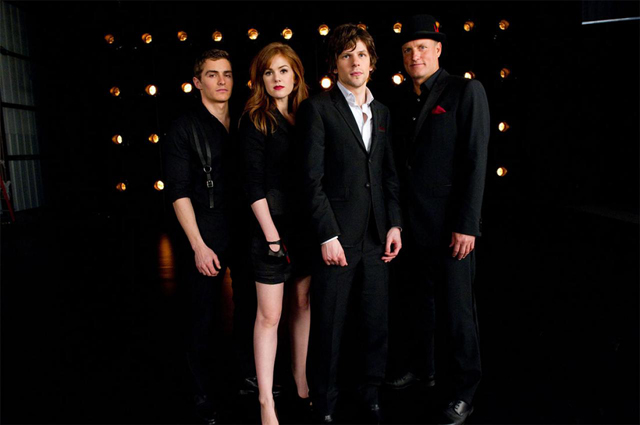
Jesse Eisenberg as J. Daniel Atlas, Mark Ruffalo as Dylan Rhodes, Woody Harrelson as Merritt Osbourne, Mélanie Laurent as Alma Vargas, Isla Fisher as Henley Reeves, Dave Franco as Jack Wilder, Michael Caine as Arthur Tressler, and Morgan Freeman as Thaddeus Bradley.

The philosophy of this movie is encapsulated inside the few words of its tagline: "The closer you look, the less you'll see." I feel that it is an apt summation of what show magic is all about. One character in the film told a story about a trick that was performed by a stage magician by the name of Lionel Shrike in which he had a volunteer sign his name on a playing card. He then supposedly transported that card into a tree. When they cut the tree down, they found the autographed playing card, encased in glass, nestled within the heart of the trunk. How could such a seemingly impossible feat be achieved?

It was then explained that Shrike had gotten the same guy to sign his name on a card decades ago for another much less impressive magic trick. Then, he entombed the card in glass in the middle of a young tree, allowing it to be swallowed by the wood as it grew. It seemed inconceivable that someone would go through such lengths to set up such a performance, but it is precisely that inconceivability that protects it from being seen through. All who witnessed Shrike's feat of prestidigitation could not figure out how he could hide a card in the trunk of a living tree in an instant without breaking it apart and then meticulously put the tree back together before their eyes. That is their failure. The thing is, the answer to how it can be done is clear from the beginning if they can only step back and look at it from afar. I have heard more than once that if you want to be a successful magician, you must know how people think and how inept they are at it.

That being said, the joys of this movie are far and few between.

Heist films and stage magic have a lot in common. They first wow us with the sight of something seemingly impossible and then it impress us with the revelation at the end. The first big trick of the Four Horsemen (Eisenberg, Harrelson, Fisher, and Franco) was robbing a French bank while being on stage in Vegas. It is also arguably the only satisfying revelation of how a trick is performed, its execution mirrored the card-in-tree-trick. The entire performance suggests that the bank was robbed in real time when in fact, it had been done long before the quartet announced their intention to do so. As Morgan Freeman's magic debunker character helpfully pointed out, when a magician asks you to look at something, he or she is distracting you from what you really should be looking at.

Of course, a lot of this film hinges on your acceptance that stage hypnotism really does work and work to the absurd degree that the film portrays (instantly putting people to sleep, entombing post-hypnotic suggestions in people's subconsciousness that dramatically affect their actions, et cetera). While it was employed to great comedic effect, the success of a film about heists or magic acts relies on how grounded in reality it is. Having actual magic (Harrelson's power of hypnosis in Now You See Me) or invoking Clarke's third law by introducing futuristic technology  that are indistinguishable from magic (Bowie Tesla's teleportation device in The Prestige) just make a film in these genres look like they copped out. I am sure that the writers could have replaced all the bits involving hypnotism to something more grounded, something more mundanely magnificent - but they didn't and as a result the film suffered for it.


Now You See Me Horsemen
The Four Horsemen.

The presence of actual effectual stage hypnotism in Now You See Me's universe is the least of its sins. The motivation of the Four Horsemen in publicly performing heists and causing them to be wanted criminals, leaving them on the run from the law for the rest of their lives, is... they wanted to join an ancient Egyptian order of Robin Hood magicians called The Eye. Yeap. It was that cartoonish and needlessly fantastic. Any halfway decent screenwriter would be able to come up with motivations more believable than that.

While the second heist was rather clever and hinged on a simple trick (Eisenberg's pantomimed failure at mentalism managing to draw out crucial private information from Michael Caine), it also made me wonder at how the foursome managed to gather hundreds of very specific people into their audience, learn of their bank account numbers and the amounts of money in them, and of their grievances against a certain insurance company. The scope of their backstage prep beggars belief even if you know exactly how they did it.

Movies such as Now You See Me often relies on a third act twist that is expected to be more impressive than everything that came before it but in this case, the third heist turned out to be the worst of the three. One wonders, if the Horsemen were able to install a huge mechanical contraption to lower a giant mirror into a room on command, wouldn't it be easier if they just outright steal the safe kept in that room in all the time they were tinkering in it? Here, the magic hypnotism appears again as a crucial element in their trick in getting someone to make a phone call. I wondered: why didn't the writers simply invoke Franco's character's skill at impersonating voices instead (one which was masterfully portrayed during the cool prestidigitation-fueled fight scene between him and Ruffalo's character)?

The ultimate reveal and twist of the film was Mark Ruffalo's FBI agent character turning out to be the mastermind behind The Eye and that he had recruited the Four Horsemen to perform these heists as a very coldly-served revenge against the people who antagonised his father, Lionel Shrike, which indirectly caused his demise at the bottom of a river due to a botched escape trick.

While Lionel Shrike's story was featured prominently throughout the film, the reveal of Ruffalo's real identity and the raison behind the targets of the heists felt like they were pulled right out of the writers' asses. They were cheap and substance-less. There were no indications throughout the film suggesting that Ruffalo is anyone other than who he appears to be. There were no clues linking the Four Horsemen's heist victims to Shrike either. It is also troubling that Mark Ruffalo's character thought that framing an old bloke and putting him in jail for making a career out of revealing how magicians perform their tricks (and very indirectly catalysed the events leading to his old man's death) is commensurate retribution.

If you can forgive all of these problems (and more I didn't talk about like the unbelievable romantic subplot between Rhodes and the French Interpol agent played by Laurent, and her ultimate decision to keep Rhode's secret and thus, damning an innocent man to imprisonment), this movie makes for quite an easy viewing. There is an undeniably cocky stylishness that this film exudes. Woody Harrelson's quips and Jesse Eisenberg's boast about being the smartest man in the room (evocative of his role as Mark Zuckerberg in The Social Network) were some of the highlights. A confrontation between Michael Caine and Morgan Freeman in New Orleans was also pretty memorable.


NOW YOU SEE ME
Special Agent Dylan Rhodes facing off Thaddeus Bradley, debunker of magicians.

Now, as I promised, I will now reveal how I produced the lilies, seemingly out of nowhere.

I actually brought it into the house when I came home from work. There was a short moment before Cheryl greeted me so I quickly left the bouquet on the counter-top in the kitchen for her to stumble on - which I was certain she would when I showered. She didn't. As we were leaving the house, I quietly stepped into the kitchen when her back was turned to retrieve the flowers (that only took a couple of seconds max). I then spent the entire evening telling her that she cannot explain how or when I brought the flowers into the house without her noticing and how it materialised in the short instance her back was turned, subtly suggesting that it was all meticulously planned when it is in fact a fortuitous exploitation of an unexpected opportunity.


I invited her to look closely and made sure she saw less. That, my friends, is how magic is done.


P.S. This post's title has more than one meaning.


Knows magic,
k0k s3n w4i

Monday, May 27, 2013

What's in a Name?

"People's fates are simplified by their names."

Elias Canetti 

In the first year of medical school, I learned every name there is for every part of my physical body, and the names of every bit of physiological sorcery that keeps me alive. In my second year, I learned the names of the legions of diseases that physicians have demystified from the darkness of ignorance, the names of the microbial demons that plague us unseen and the names of the chemical weaponry we harness to subdue them. If you are ill, I will find out the secret name of what ails you, and with that name comes its nature, and more crucially its weaknesses. There is power in names, and there is mastery in their knowledge. This is one of the primary reasons I chose Galen's burden as a profession: I wanted to know them. I wanted to gain intimate ownership of my own mortal vessel. I wanted to know the names of Death so I will not fear it.

Okay, that's enough purple-coloured grandstanding for one day.


Thing is, names are a big deal to me, so when the time comes to naming my firstborn son, I spare a great deal of thought on it. Being ethnically Chinese but having no knowledge of the written Chinese language proved to be a colossal handicap so I decided to give the kid an English name, the language my thoughts are written in, because it is the only meaningful way I can participate in shaping his name. Meanwhile, the task of coming up with the Chinese parts of his name was taken up by my wife.

Before my marriage, before I even embarked on this footpath to fatherhood (and in fact, long before I even decided that I wanted a child), I have identified the criteria by which to guide me in this task of naming - and possibly deciding the fate - of the newly-born. Some are arbitrary and some are sensible. They are as follow,
  1. It must not be the name of someone I personally know or one that is too common. I don't want them thinking that I named my kid after them, or even give them enough fuel to insinuate such a thing. Also, I don't want common names because they are unimaginative, unoriginal and undistinguished. John? Which John? Even my given name (the last two words of my three-word name) is pretty common for those that have the same surname I do. On my first day of college, I actually turned up in the wrong class after reading the rosters, realising it only when both of us raised our hands during roll call. I had to sprint across campus to get to the class I was suppose to be in.
  2. It must be meaningful. It can be the name of someone I admire or it can be a name that holds personal significance to me. It can also have a meaning hidden behind its root language - what that language is is immaterial to me. They are fun conversation trivia, if nothing else. My name means "the outer part (of a city) attains greatness", I think.
  3. It must not have religious connotations or origins. Both my wife and I are atheists so naturally, names that came from a holy book, names of gods and names with religious significance (e.g. Abdullah which means "God's servant" or Immanuel which says "God is with us") are ironic and inappropriate. Besides, the sheer volume of people having names such as Muhammad, Peter, Isaac, Timothy and Paul really makes clichés out of them, violating my first criterion as well.
  4. It must be a real name, not rare, and aren't a real name spelled weirdly. I don't want to make one up from scratch and have my child be the only person ever to have that name (no matter what delusions of uniqueness I may harbour for him), and I don't want it to be too obscure or too flashy either. There are studies which showed that having an uncommon name (the so-called ghetto names like Shaniqua, Laquisha or Beyoncé) are correlated with juvenile delinquency but that could simply be because of poor socioeconomic status being predictive for both ghetto names and bad behaviour. Other studies found that having unusual or "black" names is correlated with poor grades in school while siblings of said unfortunately named children that have more conventional names did better, suggesting that the names themselves have predictive power aside from their association with socioeconomic factors. Common names with a "clever" deviant spelling (like Peter being spelled Petyr) is correlated with slowed spelling and reading capabilities. Boys given traditionally girly names like Alexis, Courtney and Kelly are found to display disruptive behaviour and have serious disciplinary issues. While I don't want dirt common names as per criterion one, I am certainly looking for a name that is instantly recognisable.
  5. It must roll off the tongue easily. Because if it's hard to call a person by it, then it is not doing a good job as a name. So names like Siobhan, Saoirse and Niamh won't make my list. I don't want names with too many syllables (more than three) like Nathaniel, Elizabeth, Horatio or Alexander either, even if they have simple diminutives.

An unspoken 6th criterion is that I must like it (though that goes without saying). After testing out hundreds of names against my criteria, I finally settled on one that fulfills everything I want in a name for my son. I initially meant to keep it provisionally, thinking that I'll think of a better one over time but I never did. In the meantime, Cheryl and I started addressing her belly using that name. Now, we can't imagine our kid having any other.

In the meantime, you can try to guess what it is. Just for fun, what names do you know that would pass my 5-point baby name screening checklist? How many names do you know that are meaningful, have no association with religion, is uncommon yet not too common, instantly recognisable, easily pronounceable and spelled conventionally?


P.S. Having worked almost two years here in Sarawak, I noticed that Iban and Bidayuh parents have a tendency to give very unusual names to their progenies. I know a nurse called Javelin and another called Sway
ze Patrick (her dad was a fan of Dirty Dancing). I'd name some of my patients but I don't think I'm allowed to make fun of them like that. They certainly paid heed to criterion one while gleefully violating criteria two to five in every orifice imaginable.


A proper noun,
k0k s3n w4i